
 English
 Русский
 Español
 简体中文
 العربية
 Français
 Bahasa Indonesia
 한국어
 Português
 Deutsch
 日本語
 हिंदी
 Türkçe
 Tiếng Việt
 Italiano
 ไทย
MATERIAL GUIDE | FOOD PACKAGING
Choose the material around the food, not the other way round
There is no single best material for every food packaging box. A retail carton for individually wrapped snacks has a different job from a takeaway box or an outer shipping case. Start by defining product protection, direct-contact conditions and the distribution route, then compare materials against those requirements.
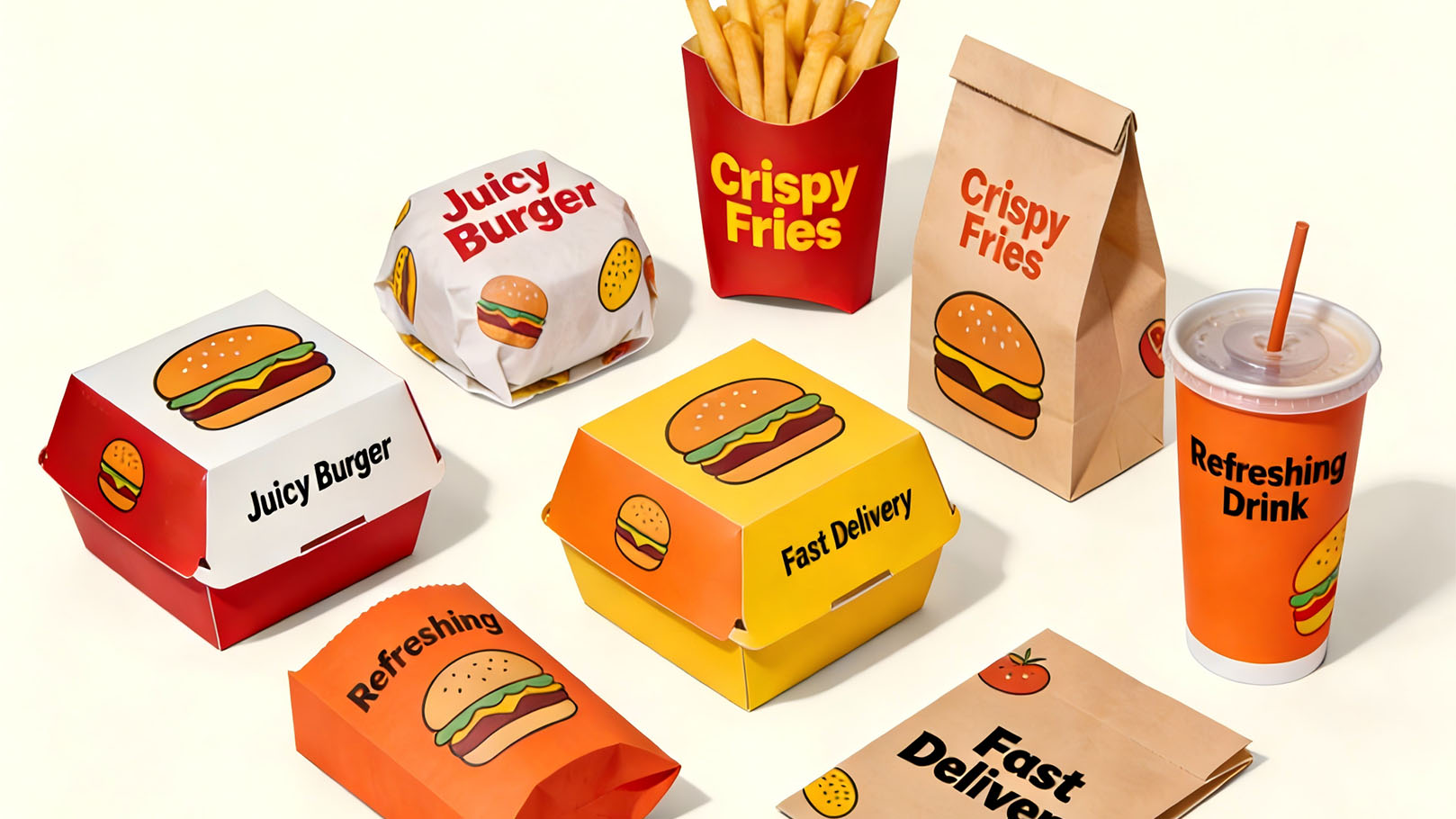
Food-service packaging combines different formats. Appearance alone does not establish material grade, food-contact suitability or barrier performance.
1. Compare the main material directions
| Material direction | Applications to evaluate | Key trade-off |
|---|---|---|
| Folding paperboard | Retail cartons, sleeves and dry-food outer packs | Compact structure and printable surfaces; review moisture and grease needs. |
| Corrugated board | Shipping boxes and protective outer packs | Evaluate flute, board grade, load and stacking conditions. |
| Molded pulp | Shaped inserts and product separation | Check fit, surface finish, moisture exposure and consistency. |
| Barrier structures | Applications needing sealing or moisture, grease and aroma protection | Assess the complete liner, coating or inner pack and its recovery route. |
These are starting points for evaluation, not universal specifications. Paperboard, corrugated board and molded pulp can each require additional protection depending on the food and use conditions.
2. Separate the box structure from the food barrier
The outer box may provide stiffness, presentation and handling, while an inner pack provides sealing or barrier performance. Decide which component does which job before adding layers or increasing board weight.
Dry or individually wrapped products: compare fit, print quality, folding and closure.
Greasy or moist foods: define the required resistance and review the full coating or liner system.
Chilled or frozen distribution: evaluate condensation and performance under the actual temperature cycle.
Tea, coffee and aromatic products: consider the inner-pack seal and aroma protection alongside the carton.
3. Let the format guide the structural review
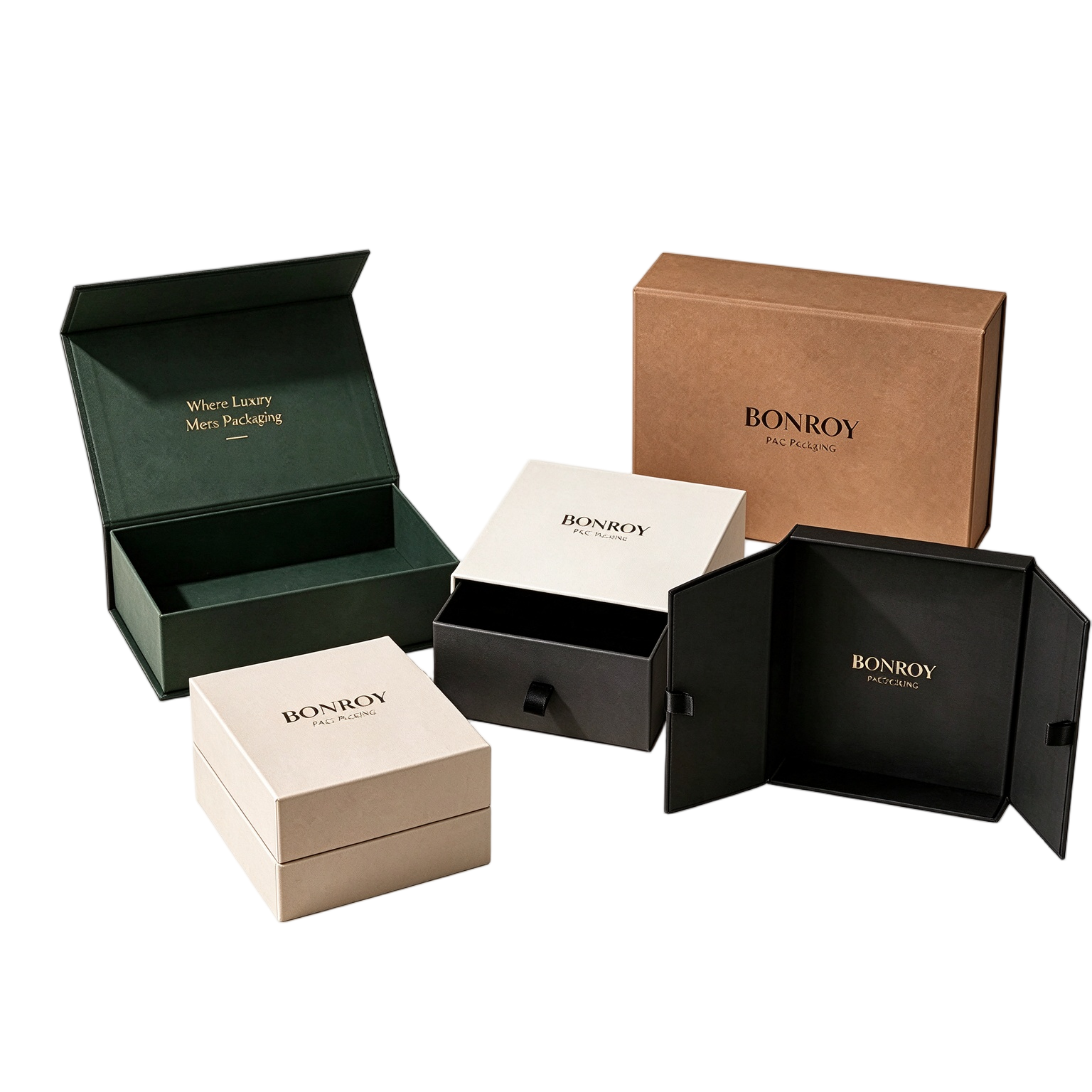
Box-format reference from the Bonroy image library. A similar appearance can use different board grades or constructions; confirm the specification on a sample.
A gift set may need a rigid presentation and fitted insert. An e-commerce shipment may place more emphasis on impact protection and stacking. For either application, compare the complete pack: dimensions, empty space, inserts, closure and packing method.
Using a thicker board is not automatically the best response to a structural problem. Review the dieline and load path, then validate any material reduction with the actual contents.
4. Review every layer and every claim
Paper-based packaging can contain coatings, adhesives, inks, films and other components. Include them in the material specification rather than judging the pack by its outer surface.
For direct food contact, define the food type, contact time, temperature and destination market, and obtain the relevant supporting documentation. Recycled content, recyclability, compostability and biodegradability are different characteristics. Any claim should match the actual construction, evidence and target-market conditions.
5. Approve samples before volume production
Fit and filling: test the real product, inserts and packing sequence.
Structure: assess folding, closures, handling and loaded stacking.
Exposure: check moisture, grease or temperature conditions relevant to the product.
Distribution: validate protection for the planned shipping and handling route.
Print: approve artwork, colour references, scuff resistance and small-text legibility.
Documentation: record the material grade, grammage or thickness, coatings, dimensions, tolerances and approved versions.
Digital proofs support communication; physical samples establish whether the chosen structure works in practice. Keep the approved sample and specification aligned when ordering again.
Build a clear brief with Bonroy
Share the food category, product dimensions and weight, direct-contact needs, destination market, shipping route, quantity and presentation goals with Qingdao Bonroy Packaging Co., Ltd. These details help focus the comparison on viable material structures and the tests needed before production.
The practical selection sequence: define the use → compare structures → document materials → test samples → approve production.
The future of food packaging will be shaped by fit-for-purpose design rather than by one material replacing all others. Brands that evaluate performance, compliance, production efficiency, consumer experience and end-of-life handling together will be better positioned to develop packaging that is both commercially effective and technically credible.
For packaging buyers, the best next step is not to ask which material is universally “greenest” or “strongest.” It is to define the product’s real requirements, compare viable structures and validate the final choice through documented samples and testing.


